Deadline on mental health in students
- Florentina Cercel
- Apr 28, 2022
- 2 min read
By Florentina Cercel

The talk around mental health is a topic that is still stigmatised, disregarded or challenged even up to this date due to the misinformation and misunderstanding of the topic in that regard.
Concerning UK based students, the Mental Health Organization reported that in the UK “nearly nine out of ten people with mental health problems say that stigma and discrimination have a negative effect on their lives.”
In 2021 UCAS reported that 3.7% of all UK applicants declared a mental health condition in their application to study in 2020 – up from 0.7% in 2011, women being 2.2 times more likely to declare a mental health condition than men.
Psychology student, Jemima Vungbo, said that while being at university her mental health has declined.

Person screaming. Photo by Anton Malanin on Unsplash
“I’m not happy like I used to be and I’m always feeling stressed and down as a result of dealing with assignments and exams. It’s all pretty overwhelming and I feel as though I've been lacking motivation a lot when it comes to doing things, inside and outside of the university.”
Vungbo added that “ I tried to reach out but I felt as though I wasn't being listened to and this is the main reason why I didn’t consider asking for further help or talking to others about my mental state and issues I was having.”
In 2020, in an investigation into student wellbeing report, the UK branch of the recruitment company Randstad UK reported that 64% of respondents claim that their studies and university lifestyle impact their state of well-being negatively, while only 42% accessed counselling support.
Mental health is not something to turn a blind eye to.





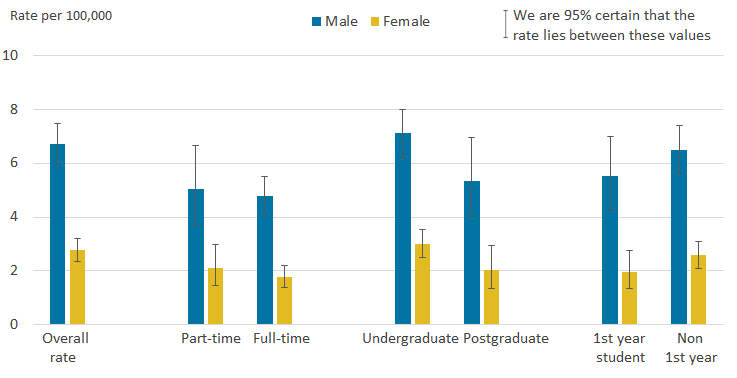


Statistics on suicide rates in the UK. Source: ONS
Leah Ryan, a second-year student at the University of Greenwich, said that when dealing with mental health issues, her tutors were supportive to a certain degree.
“My mental health has severely declined. I would have mental breakdowns more often and have a freeze moment of not feeling or wanting to do anything,” said Ryan in regards to her mental health state while studying.
In terms of open conversation between peers, Ryan mentioned that it’s easier to have it with them rather than with a tutor. “We’re all somewhat feeling the same mentally and physically so it’s much easier having that type of conversation,” she added
One of the most recent reports from the Office for National Statistics (ONS) outlined that between 2001 and 2017, 66% of male students and 34% of female students died by suicide, with undergraduates accounting for 83% whereas postgraduates 17%.

Fig.1: Number of higher education student suicides by year, deaths registered in England and Wales. Source: ONS
“I think there is more universities can do, in terms of helping students with mental health, as at the moment, most attitudes seem very aloof to the concept of mental health in students,” said Vungbo.
“People need to realise that a lot of young people are dealing with such issues and should be provided with extra support.”


Comments